CARBON DIOXIDE TEST PROCEDURES Proprietors of bonded wine cellars
and others concerned: Purpose. The purpose of this industry circular is to announce
authorized test procedures for determining carbon dioxide in still
wines where such carbon dioxide is added to or retained in the wines
under the provisions of 26 CFR 240.531 through 240.534. Background. Public Law 85-859 amended the Internal Revenue Code
of 1954 to provide that limited quantities of carbon dioxide may be
added to or retained in still wines. These provisions were implemented
by amendments of 26 CFR Part 240. Such amendments provided that author-
ized test procedures for determination of the quantity of carbon dioxide
in still wines would be announced by the Director, Alcohol and Tobacco
Tax Division. Procedures authorized. The authorized procedures for determining
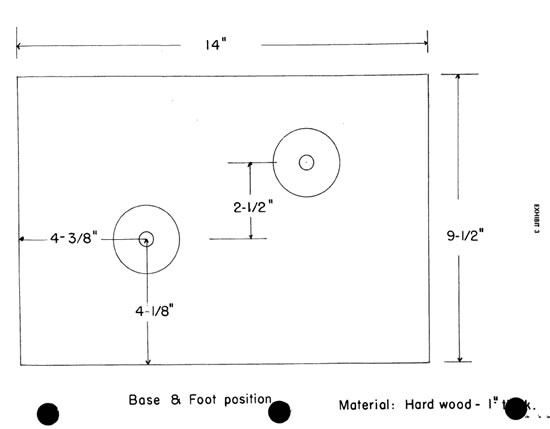
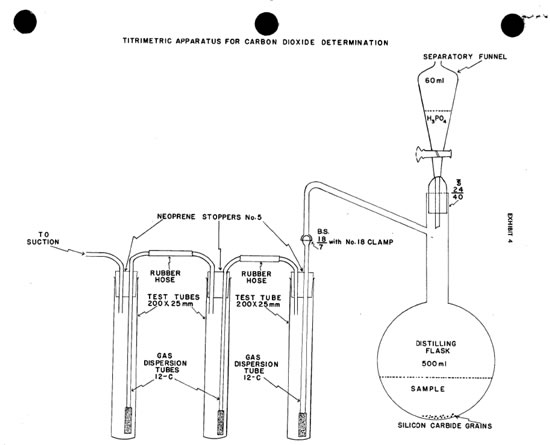
the quantity of carbon dioxide in still wines are described in Exhibit 1
and apparatus used in the procedures is depicted in Exhibits 2, 3, and
4. Two procedures are provided. One is designated as the "Gasometric
Procedure" and the other is designated as the "Titrimetric Procedure."
Either procedure may be used. The method of preparation of the sample
is common to both procedures. Inquiries. Inquiries in regard to this industry circular should
refer to the number thereof and should be addressed to the office of
your assistant regional commissioner (alcohol and tobacco tax). 
Dwight E. Avis
Director, Alcohol and Tobacco Division Attachments:
Exhibits 1, 2, 3, and 4 IRS-D.C.-50287
EXHIBIT 1 AUTHORIZED TEST PROCEDURES Preparation of samples. Chill the unopened bottle of wine in an
ice-salt bath which is slightly below 32° (30 minutes for 1/10
and 1 hour for 1/5 gallon bottles). Open the bottle of chilled wine
and add 1.5 ml of 50% sodium-hydroxide per 100 ml of wine. Stopper
the bottle and agitate. Reagents: (Common to both procedures) Phosphoric Acid - reagent grade (85%)
Hydrogen Peroxide - 10% (For destruction of sulfur dioxide)
Sodium or potassium bicarbonate - reagent grade
(Before use, dry over sulfuric acid for 24 hours at
room temperature)
Sodium Hydroxide - 50% by weight - Dissolve 500 grams of
solid sodium hydroxide in 500 ml of water, allow to
stand 24 hours and filter before use. Gasometric procedure. Standard sodium bicarbonate solutions: Weigh the following quantities from a freshly opened
bottle of dried sodium bicarbonate and transfer to a
liter flask with approximately 700 ml of recently
boiled and cooled distilled water. Add 200 ml of
neutral absolute alcohol, shake, cool and make to mark
with boiled distilled waters: 3.8182 grams = 200 milligrams CO2/100 milliliters
4.2955 grams = 225 milligrams CO2/100 milliliters
4.7727 grams = 250 milligrams C02/100 milliliters
5.2500 grams = 275 milligrams C02/100 milliliters
5.7273 grams = 300 milligrams CO2/100 milliliters Apparatus: Carbon Dioxide Apparatus - Shown in Exhibits 2 and 3.
Magnetic Stirrer with Teflon Stirring Bar (Fisher Fexa-Mix
or equivalent). The stirring bar should be 1 to 1-3/8
inches in length.
Vacuum Pump - Welch Dist-O-Pump, with motor single stage,
vented exhaust; to be operated with vented exhaust
Exhibit 1 (continued) valve open for pumping condensable vapors. Insert a
three-way stopcock between the pump and the apparatus
for allowing air to enter the system.
Grease - Silicone, high vacuum type. To remove this
grease from the glassware, use varsol or hot kerosene. Calibrations Pipette 50 ml of standard sodium bicarbonate solution and
3 ml of hydrogen peroxide solution into the reaction
flask. Carefully grease the joints then start the
magnetic stirrer and evacuate the system for one minute.
(Longer periods cause excessive cooling necessitating
a waiting period for reestablishment of temperature
equilibrium.) Close the system to the pump (by three-
way stopcock), gently tap the mercury columns and read
the mercury levels of the manometer to the closest
0.5 mm. At this point the mercury levels should remain
constant. (Changes indicate a leak, probably caused by
insufficient grease on the joints.) Add 10 ml of phosphoric acid and continue with rapid stirring
for five minutes. Gently tap the mercury columns and read
the total pressure in cm mercury to the nearest o.5 mm.
Record the room temperature in degrees centigrade. Open the three-way stopcock (on the apparatus) to the pump.
Then, slowly open the three-way stopcock between the pump
and the apparatus to permit air to flow into the system.
Disconnect and thoroughly wash the inner portion of the
acid dispensing unit and reaction flask. Rinse with ace-
tone (technical grade) and dry with suction. Calculations: Calibrate with each standard solution in duplicate and
calculate the average volume of the system as follows: From the total pressure in cm mercury, subtract the
vapor pressure of the ethanol-water, and the
pressure due to the phosphoric acid effect (See Table
1).
Exhibit 1 (continued) TABLE 1 - Effect of Phosphoric Acid on the Vapor
Pressure of Ethanol and Water Increase in pressure after Phosphoric
Percent Ethanol Acid Added in cm Mercury Pure water 0.67
5 0.68
10 0.69
15 0.75
20 0.77
25 0.77 Then: (Equation 1) g
0.08205 (273 + °C) M 76
V = ___________________________
P V . The volume of the system in liters.
0.08205 = Gas constant in liter atmosphere per
degree per mole.
273 + °C = Absolute temperature plus the room
temperature in °centigrade.
g = The weight in grams of carbon dioxide in
50 ml sample.
M = The molecular weight of carbon dioxide in
grams.
P = The pressure of carbon dioxide in cm mercury. Correction for the mercury displaced in the
manometer tubing: (Equation 2) V L ñ r2
m 2
L = Difference in height of mercury column in cm.
r = Radius of manometer tubing.
Vm = Volume correction - In calibrating the volume
of the system, subtract Vm from the
uncorrected volume, V; then:
Exhibit 1 (continued) (Equation 3) Vo (calibrated volume of the system) =V - Vm
In calculating the weight of carbon dioxide in
the wine, the mercury displaced in the manometer
tubing, Vm, is added to the calibrated volume of
the system, Vo; then: (Equation 4) V= Vo + Vm Analysis of Wine: Pipette 50 ml of alkaline vine (at room temperature) and
3 ml of hydrogen peroxide solution into the reaction
flask and proceed as under calibration. Solve for "g"
(grams CO2 per 100 ml wine) in the following equation
using V determined from Equation 44: (Equation 5) g=14.327 PV
____________
273 + OC
Titrimetric procedure. Reagents: Sodium Hydroxide - approximately 0.25 normal - Prepare
from 50% sodium hydroxide. Standardize the sodium
hydroxide solution against potassium acid phthalate
or other primary standard using phenolphthalein-
thymolphthalein indicator.
Hydrochloric Acid - approximately 0.25 normal -
Standardize against the sodium hydroxide solution
using phenolphthalein-thymolphthalein indicator.
(The normality of this solution should remain constant
for considerable periods of time.)
Barium Chloride - Dissolve 60-65 g. of hydrated barium
chloride in a liter of water and neutralize to
phenolphthalein. •
Exhibit 1 (continued) Restandardization: Restandardize sodium hydroxide
solution daily versus hydrochloric acid, adding
5 ml of barium chloride solution. Indicator: 1 g. phenolphthalein plus 0.5 g.
thymolphthalein in 100 ml of 95% ethyl alcohol. Apparatus: 500 ml sidearm distilling flask, Exhibit 4. (Rubber
stopper and standard distilling flask may be used.)
Glass tubing - 6 mm connecting distilling flask and
carbon dioxide traps.
3 Pyrex test tubes (25 x 200 mm)
3 Gas dispersion tubes - 12 mm fritted ends (coarse
porosity) and 8 mm stems (Fisher Catalog 11-138)
Vacuum line or filter pump. A trap should be placed
in the line. Procedure: Set up the apparatus as shown in Exhibit 4 and place
the receivers in a beaker of water (below 8O° F). Pipette 20 ml of the standard sodium hydroxide solution
into the first and second receivers and 10 ml of
sodium hydroxide plus 10 ml of barium chloride solution
into the third. Pipette 50 ml of alkaline wine into the distilling flask
and 3 ml of 10% hydrogen peroxide. Add boiling chips
(not marble). Attach the vacuum line to the last carbon dioxide
receiver and slowly increase the vacuum until bubbling
practically ceases, then open the vacuum line fully.
(This will keep the system under partial vacuum so
that on heating, the stoppers will not be blown out by
a sudden surge of steam or carbon dioxide.) Add about 5 ml of 85% phosphoric acid to the dropping
funnel and carefully admit about 3 ml into the dis-
tilling flask. Next agitate the flask gently to mix
the acid and sample.
Exhibit 1 (continued) Heat gently and when carbon dioxide evolution slows down,
heat vigorously, after a few ml of liquid have been
distilled and the top of the first receiver is warm,
all of the carbon dioxide will have been driven into
the receivers. Close the vacuum line between trap and receivers, then
slowly admit air through the dropping funnel until
atmospheric equilibrium is reached. Transfer the contents and rinsing: of the first two
receivers and spargers into a titration flask, third
also if BaCO3 has precipitated. Add 50 ml of barium chloride solution to the titration
flask and titrate with hydrochloric acid to phenol-
phthalein end point. Calculations: (Ml. NaOH x normality) - (Ml. HC1 x normality)= ml of
normal base consumed by CO2
(1 ml of normal CO2 x 0.022 g.)
0.022 x ml NaOH (consumed)x 2 x 1.015 = wt. CO2 in g/100 ml Note: Simulated samples for carbon dioxide determinations may
be prepared from sodium or potassium bicarbonate. Duplicate determinations for carbon dioxide should be made
on the wine samples. 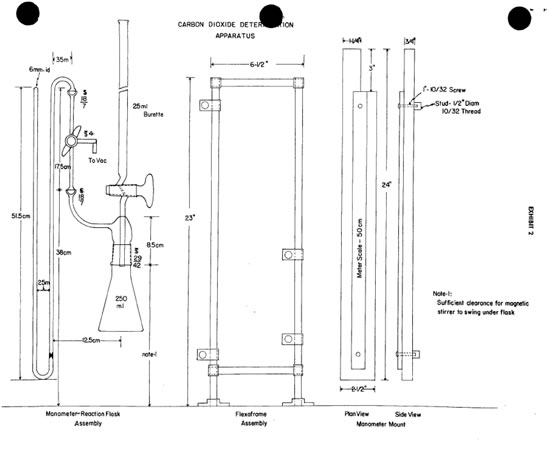
|